Here’s Your Guide To The Best 3 Month Short Courses in Australia
 Meghan Fernandes

Life is too short to commit to long courses, but three months? That’s the sweet spot. It’s long enough to build practical skills, short enough to fit around work, and far more affordable than pursuing a full degree.
Short courses in Australia can last from a few hours to six months and cover a broad range of subjects. Many of the sectors covered in this guide, such as bookkeeping, project management, MYOB, Xero, cyber security, IT and business administration, align with areas facing the strongest demand in Australia right now.
How to find the right short course for you
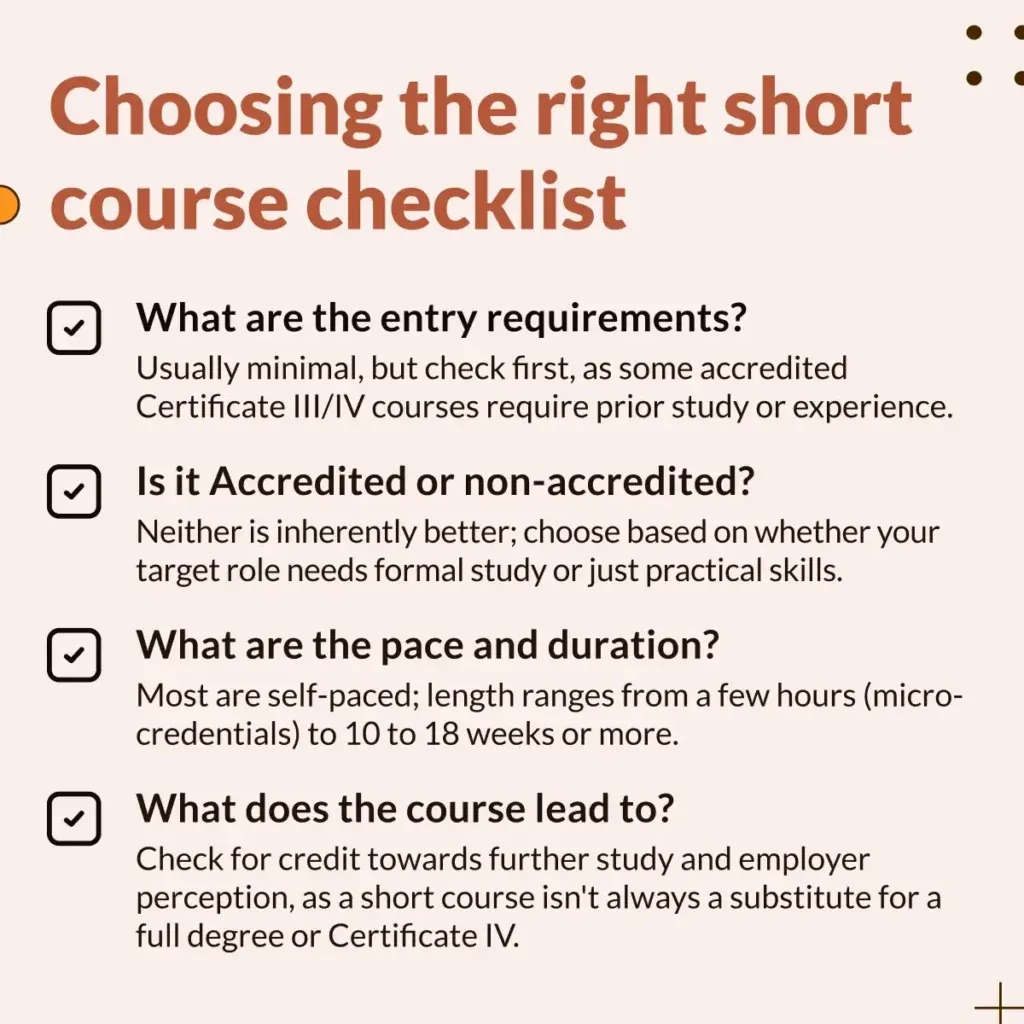
Before enrolling, it’s worth checking a few things to ensure you choose the right course for your career goals:
- Entry requirements: Many short courses have minimal or no entry requirements, which is part of why they’re such an accessible way to explore a new industry. That said, some accredited courses, particularly at Certificate III/IV level, require specific prior qualifications or work experience, so always check before you start.
- Accredited or non-accredited: Short courses can be accredited or non-accredited (skills-based training outside the formal framework). Neither is automatically the better option. It depends on whether the role you’re targeting requires formal study or just practical skills.
- Pace and duration: Most short courses are self-paced, so you can fit study around your existing schedule. However, duration varies. Some micro-credentials take as little as a few hours to complete. Most short courses run 10-18 weeks, with some extending beyond three months.
- What it leads to: Ask whether the course gives you credit towards further study and how it will be viewed by prospective employers. A short course can be an excellent first step or an add-on skill, but it isn’t always a substitute for a full degree or Certificate IV.
Not sure which of these fits you? Our course navigator asks a few questions and narrows thousands of courses into a shortlist based on your goals.

Not sure which course to choose? Let us recommend the best courses to suit you!

Not sure which course to choose? Let us recommend the best courses to suit you!
1. Xero
Xero is the cloud accounting software most small-to-medium Australian businesses use, and staff proficient in Xero are in demand across bookkeeping, admin, and finance roles. Entry-level Xero certificates can be completed in a few hours, while packages combining Xero, MYOB or payroll typically take 30-130 hours. You can study part-time and at your own pace, as these timeframes fit comfortably within three months, whether you study online or in a blended format.
Our course pick: Advanced Xero Package – a solid entry point if you want a workforce-ready Xero skill set without the longer bundled packages.
Duration: Approx. 40 hours.
Good for: Career changers heading into bookkeeping, accounts admin, or small business owners managing their own books.
Where it leads: Bookkeeper, accounts receivable, accounts administration, Xero specialist roles.
2. MYOB
Many businesses, especially smaller and longer-established ones, still run their books on MYOB. The certificates typically take 30-40 hours and provide targeted knowledge quickly if you just want to learn the software rather than pursuing a broad accounting qualification.
Our course pick: MYOB Advanced Certificate.
Duration: Approx. 40 hours.
Good for: Admin and accounts roles where MYOB is the house system, and small business owners already using it.
Where it leads: Bookkeeper, accounts administrator, or freelance MYOB consultant.
3. Bookkeeping
If you don’t want to go through with single-software training, a bookkeeping short course will help you build a broader skill set. You’ll learn double-entry bookkeeping, reconciliations, and payroll basics, and work with a range of software, including Xero and MYOB. If you’re already working in the industry, some bookkeeping short courses also count towards continuing professional development requirements.
A short course won’t get you registered as a BAS agent, as that requires formal study through a Certificate IV in Accounting and Bookkeeping (or higher), plus Tax Practitioner Board recognised experience. However, it can still count towards further study down the track.
Our course pick: Business Bookkeeping Certificate – this course is designed to be completed in around ten weeks, so it fits neatly within a three-month window.
Duration: Approx. 140 hours.
Good for: Genuine beginners testing bookkeeping as a career before a Cert IV, or small business owners wanting to manage BAS/payroll basics themselves.
Where it leads: Accounts clerk, accounts admin support, payroll clerk (entry-level roles).
4. Business administration
If you’re drawn to office environments but aren’t sure where you fit yet, a short course in business administration can help you build practical, transferable skills. You’ll learn phone and customer service, diary and email management, document preparation, communication, and basic digital tools. It’s a genuinely useful way for anyone exploring new career opportunities to build confidence before committing to a Certificate III or IV, whether it’s your first office role or a shift in your professional life.
Our course pick: Certificate in Business Administration.
Duration: Approx. 140 hours.
Good for: First-time office workers, career changers testing the corporate environment, and small business owners wanting general admin capability.
Where it leads: Receptionist, office support assistant, data entry operator, general admin assistant.
5. Project management
Project management courses vary widely, from PRINCE2 Foundation certificates that can be completed in a day to PMP pathways that take months. For a genuine three-month fit, consider foundation-level certifications such as PRINCE2 Foundation, APM Project Fundamentals, or CAPM, as these typically run in part-time or intensive formats over four to 12 weeks. Project managers work across engineering, construction, healthcare, financial services and tech. With a project management short course, you can learn solid, future-facing leadership and coordination skills that’ll help in industries adopting a more structured project delivery.
Our course pick: Prince2 Foundation – gives you a genuine foundation-level entry point rather than a senior-level pathway.
Duration: Approx. 20 hours.
Good for: People already coordinating projects informally at work who want a recognised credential, or career changers targeting project coordinator roles as an entry point.
Where it leads: project coordinator, project officer, project administrator (with PM/PMP-level roles as a longer-term target).
6. IT
IT is one of the broadest and fastest-growing categories on this list, spanning everything from networking and cloud computing to systems administration and foundational security. Most in-depth IT qualifications run for six months, so they don’t fit a three-month brief. However, what does fit is a focused, single-certification course that builds a specific, job-relevant skill set without the longer commitment.
Our course pick: CompTIA Security+ – one of the most widely recognised entry-level IT security certifications, useful as a genuine foundation whether or not you specialise further.
Duration: Approx. 40 hours.
Good for: Career changers or beginners wanting a recognised, foundational IT credential without committing to a full qualification straight away.
Where it leads: IT support roles, junior systems/network roles, and a foundation for further specialisation (including cyber security).
7. Cyber Security
Cyber security is one of the most in-demand fields in Australian tech, with organisations across the country actively hiring for roles that protect systems, networks and data. Worth flagging upfront: some of the more advanced, well-known certifications in this space are designed for people with existing industry experience rather than complete beginners, so they sit at the specialist end of this list rather than the entry-level end.
Our course pick: Certified Information Systems Security Professional (CISSP).
Duration: Approx. 40 hours.
Good for: People already working in IT or security who want to build towards a recognised, high-value credential. It doesn’t suit total beginners looking for a first career.
Where it leads: Cyber security analyst, information security manager, roles building towards more senior security manager positions, and roles building towards more senior security leadership positions.
FAQs
Will a 3-month course actually get me a job?
Short courses can build practical skills and give you something concrete to show prospective employers, but whether that translates into a job depends on the role. Entry-level positions often accept a short course alongside relevant confidence and communication skills, while more competitive or regulated roles typically require a full Certificate III/IV or higher qualification. A nationally recognised Statement of Attainment on completion always strengthens your application, even if it’s not the deciding factor.
Are short courses accredited?
A mix of both. Many skills-based courses on this list, such as most Xero, MYOB and IT certifications, are non-accredited and fall outside the Australian Qualifications Framework, while Certificate II, III and IV level courses are nationally recognised. Always check the specific listing for accreditation status if it matters to your career goals.
How long do short courses actually take?
It varies. Micro-credentials can take as little as an hour, whereas most short courses run for 10 to 18 weeks. Some practical, hands-on courses last from a few weeks to six months. Duration depends heavily on the course and how many hours you can commit each week, especially for self-paced online courses.
Can I study while working full-time?
Yes, you can. Every course type listed above is commonly offered online and self-paced, designed for people studying alongside a job, so it fits your existing schedule rather than the other way around.
What if I want to go further after a short course
Many providers offer credit transfer or recognition of prior learning for a related Certificate III or IV pathway. However, this isn’t guaranteed across all providers, so confirm it before you enrol if formal or long-term study is part of your plan.
Ready to take the leap?
Browse the full range of short courses in Australia, or answer a few quick questions with our course navigator to get a personalised shortlist. Whatever course you choose, short courses are one of the most efficient ways to build new skills, unlock new career opportunities, and stay ahead in a changing job market without the time or full cost of a degree.
Browse Results
results found:

Related Articles

